
Attendance
Alkerden Church of England Academy is committed to providing all learners with a full-time education that maximises opportunities for every learner to realise their true potential.
Missing even a few days of school may not seem significant, but it can quickly add up. Children who are frequently absent often fall behind in their learning and find it difficult to catch up, leading to gaps in understanding. Good attendance from an early age helps children build confidence, stay on track with their peers, and achieve their full potential. Regular attendance supports better learning, higher attainment, and greater confidence. It is through good attendance that learners maximise their full potential, enhancing their life chances for the future, and there is a strong statistical link between attendance and attainment.
Five reasons why attending school is so important:
- Children have the right to an education
- Parents/Carers have a legal responsibility to ensure their child attends school. Schools and Local Authorities have a duty to ensure that learners take up this right.
- There is a direct link between high absence and low attainment in school.
- Getting learners to attend school regularly and be on time is an essential skill for life.
- Poor attendance can lead to learners being isolated from their friends, at risk of bullying, poor and unsettled behaviour, anti-social behaviour or criminal activity.
Attendance Tips: How can I help my child attend school regularly?
- Establish a consistent bedtime and morning routine.
- Prepare the night before. Pack bags, lay out uniforms, and get homework ready to reduce morning stress.
- Set an alarm and wake up early. Give enough time for breakfast and getting dressed without rushing.
- Encourage a positive attitude about school. Talk about the day ahead, highlight exciting lessons, and celebrate achievements.
- Address worries early, if your child feels anxious about school, speak with teachers or the pastoral team to find support.
- Model punctuality, children learn from seeing parents value being on time.
- Wherever possible, schedule medical or personal appointments before or after school or during the school holidays.
- Reward good attendance. Praise or small incentives for being on time can reinforce positive habits.
Facts and figures on Attendance
- 90% attendance equals 19 days of missed school, which is also half a day of school missed every week, and 95 hours of learning lost
- One school year at 90% attendance = 4 whole weeks of lessons and learning missed
- 90% attendance over 5 years of secondary school = half a school year missed
- There is a direct correlation between low attendance and future employment prospects

Punctuality
- Under the Education Act, parents and carers have a legal responsibility to ensure their children attend school regularly and arrive on time.
- Our school day begins promptly at 8:40am and ends at 3:10pm. Learners should be arriving through the pedestrian gate no later than 8:35am to ensure they arrive in their form classroom on time for registration.
- Learners arriving late but before 9:15am will be issued a same day break-time detention.
- Learners arriving late from 9:15am onwards will be issued a same day break and lunch time detention.
- Learners who arrive from 8:50am must sign in at the main office before they go to their first lesson.
- It is very important that the office is informed daily if your child is going to be late. If you are aware your child is going to be late, please telephone or email the school office with full details. If a learner arrives late after 8:50am and no suitable explanation is provided, this will be marked as unauthorised.
- Learners who accumulate up to 20 minutes of lateness to lessons throughout the week, will receive a 20 minute after school detention on the following Monday.
- Learners who accumulate more than 20 minutes of lateness to lessons throughout the week, will receive a 50 minute after school detention on the following Monday.
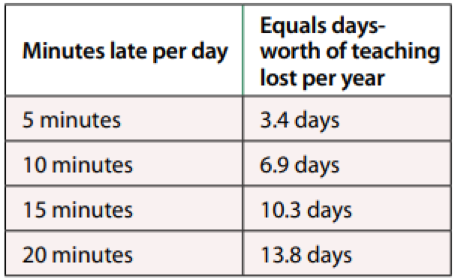
- Statistics: If your child is late every day by 5 minutes your child would have lost approximately 3.5 days from school.
What do I do if my child is ill and cannot attend School?
- Parents or carers must inform the school by telephone or email before 8:40am on the day of the absence (Phone: 01987 591 477, email absence@alkerdenacademy.co.uk)
- Parents must contact the school every day their child is off.
- To help us accurately record absences, we kindly ask for a clear reason rather than general terms. If absence is not reported to the office daily, it will be marked as unauthorised.
- Children can attend school with minor ailments (toothache, headache, stomachache, cold, sore throat). If you are unsure how long your child should be absent with an illness, contact the school office, GP or pharmacist for advice.
My child needs a medical appointment or orthodontic treatment during school time – What should I do?
- We completely understand that certain medical appointments, such as orthodontic treatments, have to be carried out in school time, and parents have very little choice on the times that they are offered. In these cases, we only ask that we are given advance warning and learners return to school as quickly as possible.
- For all other appointments (such as doctor or dentist) we ask that, where possible, these are made outside of school hours. Whole days will not be authorised for routine appointments.
- Learners who are off school for more than 3 days will also require medical evidence to be given to the school. This can be a GP appointment card or medication/prescription.
Can I take my child out of school for any other reason?
- It is not in your child’s best interests to miss any schooling. Every school day counts towards your child’s future. Days off school add up to lost learning.
- Your child is at school for 190 days and at home for 175 non-school days a year.
- This time not at school gives families ample opportunity to go on holiday, visit relatives, taking long weekends, birthday treats or special days out, to go shopping etc.
I am concerned that my child is not ill but does not want to come to school – What should I do?
Please inform the school, we can offer advice, support and strategies to work together to rectify the situation.
Useful Links
- Education Hub | Everything you need to know about attendance
- GOV | Attendance and Absence
- GOV | Link between attendance and attainment
- KCC | School Attendance: A guide for parents and carers
- NHS| is my child too ill for school?